
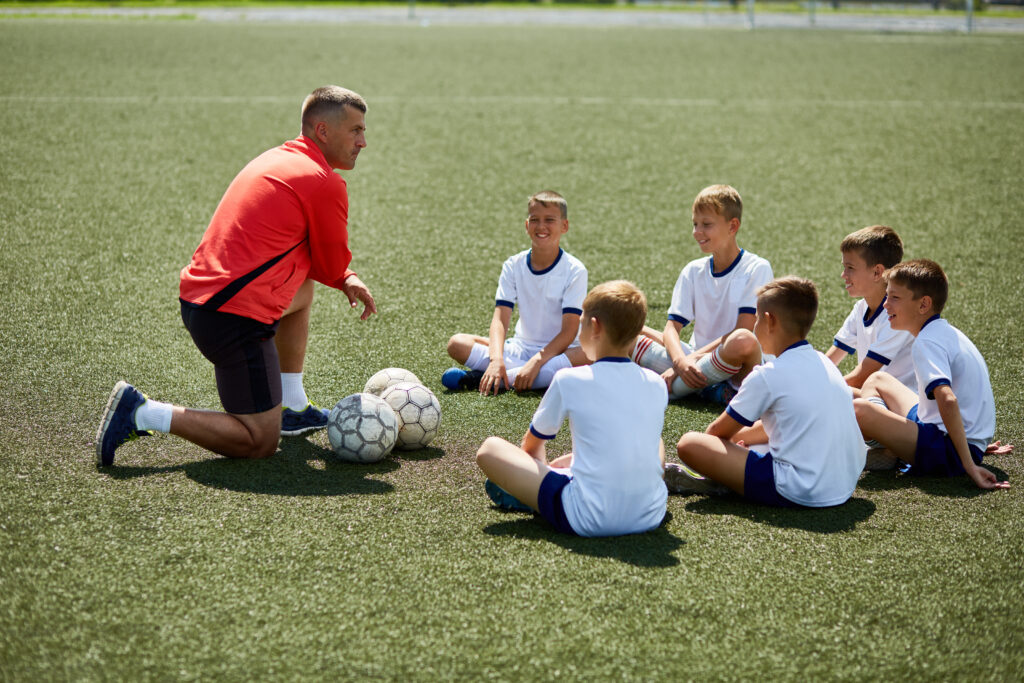
When you start coaching, you often want to do well and show that you know your stuff. As a result, every inaccurate pass, every poor control, every questionable positioning becomes an opportunity to intervene. You stop the game, reposition the players, and add instructions. On paper, the idea makes sense: the more you correct, the more the team should improve. But on the pitch, this reflex to correct everything immediately can quickly become counterproductive, especially with children.
1. Why stopping the game all the time is a problem
The first problem is that the rhythm of the session is constantly broken. Players spend more time listening than playing, when they learn best by repeating game situations and touching the ball often. Too many stoppages reduce intensity, concentration and enjoyment. By hearing ‘stop’ every thirty seconds, children end up tuning out, looking away or talking to each other during explanations. Without meaning to, the coach also sends a negative message: every action seems to be a mistake that needs to be corrected. Over time, this can undermine confidence, reduce initiative and make players ‘dependent’ on the coach’s voice to act.
2. Let them play… but not just any old way
However, the idea is not to say nothing or let anything go. The coach’s role is to help players improve, but at the right time and in the right way. A good habit is to let the game play out for a few minutes, then intervene briefly with one or two ideas at most. Before starting an exercise, it is useful to choose a main objective (e.g. the quality of the first touch or body orientation) and focus your corrections solely on that. Instructions should be simple, short, age-appropriate and, if possible, accompanied by a quick demonstration rather than a long speech. You can also correct ‘gently’ without stopping everyone: whisper a tip to a player during the action, take advantage of a break to review a situation, or ask a question (‘What else could you have done here?’) rather than giving a ready-made solution.
3. How to correct without interrupting everything
At the end of a session, a young player may not remember all the technical instructions, but they will remember whether they touched the ball often, whether they were allowed to try, fail, and then try again, and whether their coach encouraged them or just corrected them. The number one mistake made by novice coaches is not correcting, but wanting to correct everything right away. By learning to choose when to intervene, to give players more space to play, and to value effort as much as results, you create an environment where children truly progress… and enjoy coming back to training.
4. The right reflex for a novice coach
A good novice coach is not one who corrects everything immediately, but one who knows how to choose the right moment to intervene and who allows enough freedom for players to learn by playing.