
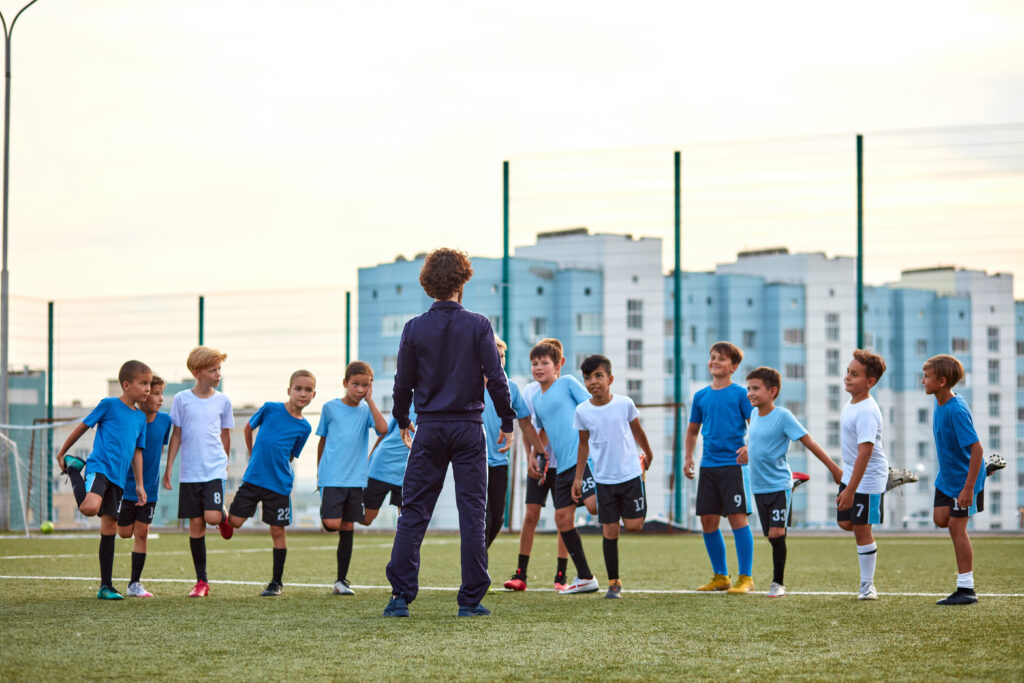
Between discussions, jokes and excitement about the ball, it’s normal for a group of children to find it difficult to stay focused during training. At times like these, raising your voice or making lots of comments is usually not enough. Worse still, it can create a tense atmosphere.
The good news? With a few simple habits, a coach can regain control without becoming a police officer at every session.
1. Set clear boundaries from the start
Concentration isn’t just built when the group gets restless. It’s prepared beforehand.
At the start of the season, and then at the start of each session, clearly explain how things will work. Specify when it’s okay to laugh. Indicate when it’s time to listen. Say what you expect during explanations.
Simple rules are enough. For example:
Keep the ball at your feet or in your hands while talking.
Look at the coach.
No shooting at the goal during instructions.
The more routines are repeated, the more naturally children will integrate them.
It is also effective to always gather in the same place on the pitch for instructions. This meeting point becomes a reference point. When the coach calls, the players know what to do. They understand what is expected of them.
2. Use signals and instructions appropriate for their age
Children respond better to simple signals than to long speeches.
A specific whistle. Repeated clapping. A countdown (‘3, 2, 1…’). These methods quickly capture their attention. The important thing? Always use the same gesture in the same way.
Once silence has been restored, instructions should be short, precise and appropriate for their level. One idea at a time. Concrete examples. Possibly a quick demonstration.
In addition, limiting the length of explanations helps a lot. After 30 to 40 seconds, most children lose interest. It is better to give instructions, start the exercise, and then adjust as you go along rather than explaining everything at once.
3. Keep players active and involved
he more static an exercise is, the harder it is for children to stay focused. Long queues where they touch the ball every two minutes quickly lead to chatting and distraction.
So, to keep their attention:
Reduce the size of the groups. Each player will touch the ball more often.
Allow very little downtime between repetitions.
Vary the roles (attackers, defenders, goalkeepers) and challenges to avoid monotony.
Giving responsibilities also helps a lot. Appoint a drill captain to help set up the equipment. Choose a player to keep score. Assign someone to make sure the rules are followed.
When children feel useful, they remain more engaged.
4. Remain consistent and positive in your reactions.
Even with a good framework in place, there will always be moments when some players lose focus. The important thing is to react calmly and consistently.
Remind them of the rules. Make individual comments if necessary. But do not shout constantly. Do not try to humiliate them.
At the same time, rewarding good behaviour is just as important as correcting bad behaviour.
Thank the group when they quickly form a circle. Praise a player who helps refocus their teammates. Emphasise: “I like it when you’re focused like that. We make much faster progress. “
These small messages encourage the behaviours you want to see repeated.
Conclusion
By combining a clear framework, simple signals, dynamic exercises and a consistent attitude, the coach no longer needs to ‘fight’ to get silence.
The children gradually understand that listening and enjoying playing can go hand in hand.
Training becomes more effective for everyone.